


Why Sour Fruits Tastes Sweet with Miracle Berry
- Andrea Dy
- Mar 18, 2020
- 3 min read
Updated: Feb 15, 2021
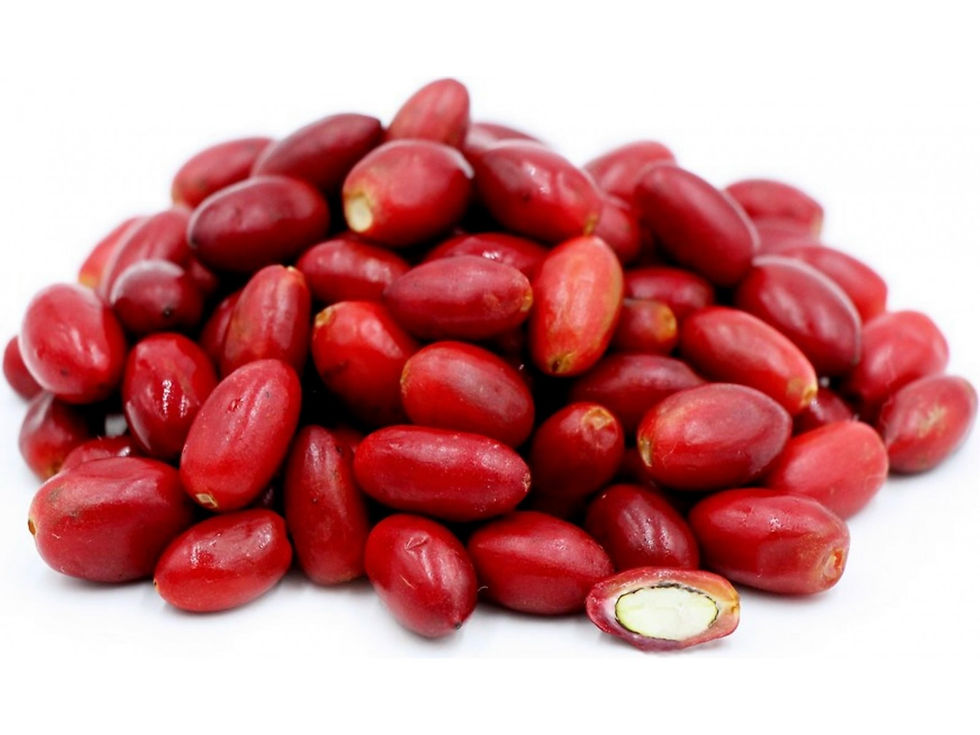
There have been several articles talking about the benefits of using Miracle Berry as a sweetener or a sugar substitute, but there is not much that discuss about the history and science behind it all. Miracle Berry, or better known as the miracle fruit, is a type of red berry that comes from West Africa and has been used by local tribes for centuries. It was discovered in 1725 by Chevalier des Marchais, a French explorer, cartographer, navigator, and captain of a slave ship that traveled extensively in the west coast of Africa, the West Indies, and the northwest coast of South America between 1704 and 1727, under service to the King of France. Chevalier des Marchais was the one who noticed how peculiar it was that people were chewing the berries before meals. He, then, came to the realization that the natives were actually consuming the miracle fruit to enhance the taste of food that was rather sour. Although the people in the area were already familiar with the different beneficial properties of the fruit, it wasn’t until the year 1968 that the miracle berry would be brought to the United States for the very first time.
In 1968, when the fruit was first brought to the United States, scientists were able to isolate the active protein that was responsible for producing the sweet taste in the miracle fruit. Because they found it so miraculous that it was making things sweet, that is how it came to have the name miraculin. Miraculin is a protein that sweetens food that is naturally on the sour side when it binds to the taste receptors in our tongue. A person has taste receptors that each identifies between sweet, salty, sour, bitter, and savoury. In this case, miraculin activates the sweet taste receptors when triggered by sour (acidic or low pH level typically from 2pH to 5pH) types of food.
📷


Interestingly enough, miraculin does not taste sweet at all when taken on its own. The reason for this is because, at a neutral pH, miraculin binds and blocks the taste receptors, whereas when it is at a low pH level (resulting from the ingestion of sour foods), miraculin binds proteins and activates the sweet taste receptors, resulting in the perception of sweetness, to which the effects would last up to more or less 30 minutes or simply until the protein is washed away by saliva. This was explained further by Ayako Koizumi from the University of Tokyo, in her study of the fruit.
The general idea is that miraculin completely changes the shape of proteins on our tongues. These proteins are usually set off by sugars, but when miraculin disfigures them, they respond to acids too. That is when sour mouthfuls are suddenly registered as sweet ones. According to Koizumi in a much more detailed explanation, miraculin sticks directly to sweet receptors and latches on more strongly compared to some other conventional sweeteners like aspartame or saccharin. In conditions of neither acidic nor alkaline, miraculin stops these other sweeteners from getting a hold on the sweet receptors. It represses the receptors, meaning they are kept from doing their job. Under acidic conditions, the opposite happens – miraculin supercharges the sweet receptors. It distorts them into an active shape, while also making them extra-sensitive to sweeteners like aspartame.
If the thought of a natural sugar-free sweetener doesn’t tantalize your tongue, I don’t know what will. So, don’t wait any longer and buy the richberry freeze-dried miracle berries now!

Explore richberry with unlimited possibilities!
For inquiries or more information, you may follow us on these social media platforms:
Facebook: https://www.facebook.com/richberry.ph/
Instagram: https://www.instagram.com/richberry.ph/
Twitter: https://twitter.com/richberryph/
Pinterest: https://www.pinterest.co.uk/richberryph/
Tumbler: https://richberry.tumblr.com/
Citations:


Comments